The Tell NY Dispatch: We’ll Always Have Paris
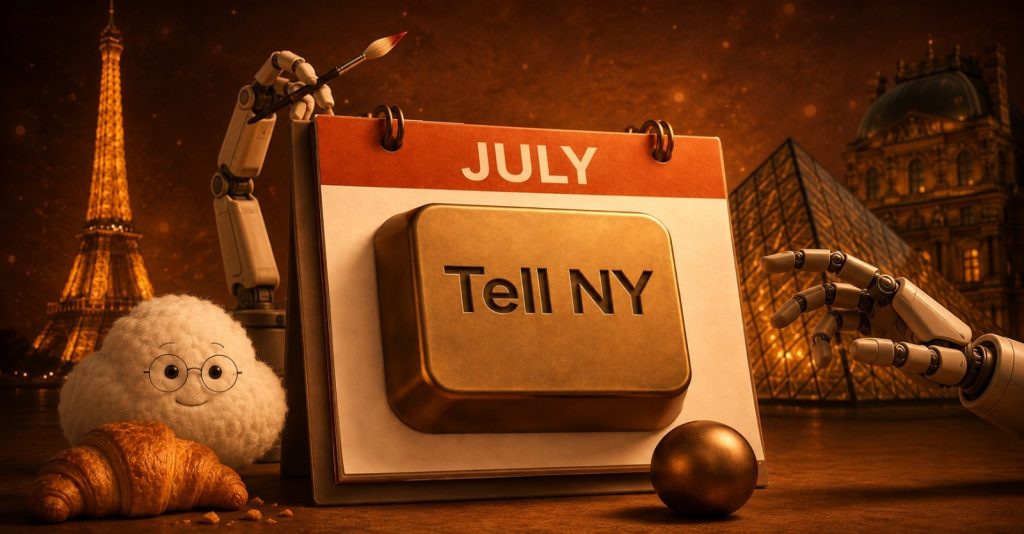
Bonjour! As you can probably tell, this month's newsletter cover is a little busier than usual. Turns out, July was too. Between viral launches, Paris, robots, croissants, and a media debate that took over Tech Twitter, we had no shortage of stories worth talking about. Let's dive in.
Everyone Has a Take
If you work in PR, you’ve probably seen the debate around the robotics startup that publicly criticized WIRED after receiving an exclusive article.
The article described the robot’s soft design and humanlike movements as strangely intimate, focusing heavily on the way the company presents touch, closeness, and physical interaction between people and machines. Rather than treating the hands purely as a technical achievement, the story questioned whether the company’s marketing was intentionally giving the robot a sexualized quality.
The company’s VP Product published an aggressive email he had sent to the writer, saying that he felt betrayed, accusing parts of the journalism community of dishonesty and malice, and ending by wishing the reporter luck with the rest of their career. He also said he regretted listening to the PR team’s recommendation to offer WIRED the exclusive.
Over the past few weeks, we’ve seen every possible takeaway. Some argued founders should trust reporters more. Others said they should trust them less. Some blamed PR teams for not setting expectations, while others argued this is exactly why founders should build their own audiences instead of relying on traditional media.
What this conversation does highlight is how much happens throughout the story-building process as a whole. A lot of people think media preparation is about polishing talking points (and it is, to some extent), but another valuable part is understanding the reporter. What’s the story they’re actually trying to write? Which ideas seem to resonate with them? Which questions keep coming back? Where are they skeptical?
You can never control the final article, nor should you expect to. But great media relations have never been about control. What you can do is reduce surprises, build trust, and make sure both sides walk into the conversation with a shared understanding of the story they’re trying to tell.
👉 WIRED article: https://www.wired.com/story/the-1x-neo-robot-has-freaky-fast-fingers/
Raise the Roff
We spent the beginning of the month at the RAISE Summit in Paris; here are a few points on what made this conference feel so different.
The first answer was obvious: the location. It’s much easier to convince thousands of people to fly across the world when your conference takes place at the Louvre and kicks off with a party at the Palace of Versailles. The location, and the fact that Paris is a really fun destination for a business trip, attracted an incredible concentration of founders, investors, executives, and operators who might not have made the trip otherwise.
That led to the second thing we noticed: the quality of conversations. When CEOs of some of the world’s biggest technology companies are all walking the expo floor, stopping by booths, and grabbing coffee between sessions, the networking becomes just as valuable as the agenda itself. It wasn’t unusual to bump into people like Mark Cuban, Molly O’Shea, or Anton Osika between sessions, making the event feel less like a conference and more like a gathering of the people shaping the future of AI.
Another thing RAISE got right was recognizing that the media has changed. The people covering the event weren’t just reporters from traditional publications. Podcast hosts, creators, independent journalists, and industry influencers were everywhere, reflecting the reality of how many people now consume technology news.
We were happy to be part of RAISE alongside so many incredible companies, including Wiz, Decart, Irregular, Team8, Greenfield Partners, and Armis, among others.
See you in Paris next year. We’ll save room for another croissant!
Everything Everywhere All at Once
One thing we love about tech PR is that no two launches should look the same. This past month also reminded us that, as different as they may be, they can be equally fun and impressive.
Take Sable, for example. The company launched out of stealth with a Fortune exclusive, but what really made the launch stand out was its social strategy. To introduce Aiden, their cloud-shaped AI agent, the team created a simple but incredibly memorable visual identity. Combined with a launch video that spread quickly across social media, carefully timed posts, striking visuals (and the fact that Aiden is also crazily cute), it turned the launch into one of our favorites of the month.
Then there was Enigma. Alongside their TechCrunch exclusive and TBPN interview, we worked with the team on creating as much buzz around launch day as possible. The company unveiled the world’s first website where anyone could interact with real AI-powered robots in real time, and if you happened to be in San Francisco on Monday morning, you probably saw the thousands of posters across the city or the LED truck livestreaming those robots as it drove through downtown.
Both launches were completely different, but they shared one thing in common: the exclusive article was just the starting point. The branding, social strategy, and launch-day moments were what gave people a reason to keep talking long after the story was published.
Onward 🚀
👉 Fortune (Sable): https://fortune.com/2026/07/16/ai-employee-that-convinced-sequoia-to-invest-45-million-in-sable-shaun-maguire/
👉 X (Sable): https://x.com/Nim_Ravid1/status/2077785419912188236
👉 TechCrunch (Enigma): https://techcrunch.com/2026/07/27/enigma-raises-70m-to-make-controlling-a-robot-as-easy-as-adjusting-the-volume
👉 X (Enigma): https://x.com/Enigma_AI/status/2081782885535912338